Faraday's Candle Lectures, read slowly
In December 1860, Michael Faraday stood in front of a young audience at the Royal Institution in London and spent six evenings talking about a candle. Not a machine, not a new element: a candle. Where the wax goes, why the flame is bright, what comes out the other end. By the last lecture he had walked the audience from the flame to hydrogen, oxygen, the atmosphere, and the breath of a living creature.
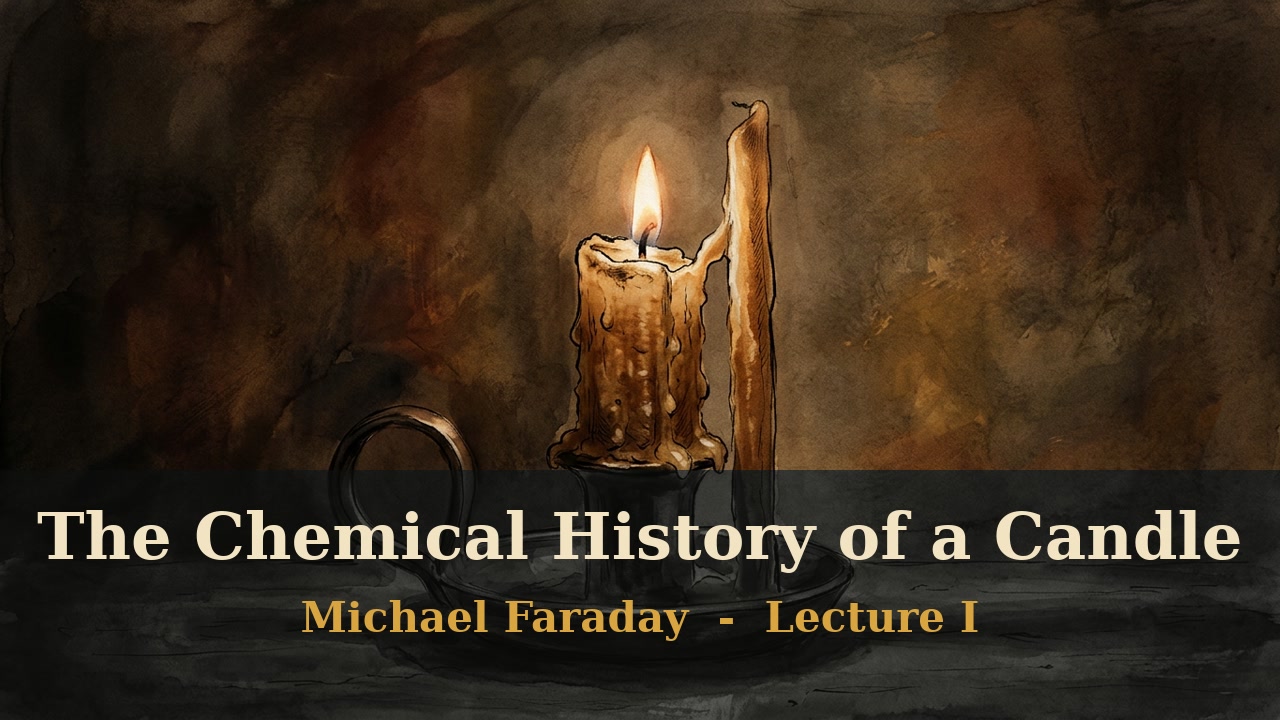
I have recorded the whole series as slow, quiet narrations with painted illustrations. No music, no sudden sounds, roughly half an hour each.
Watch
| Lecture | About | Length |
|---|---|---|
| I | The candle itself: the flame, the melted wax, how a candle burns | ~32 min |
| II | The brightness of the flame, the air a candle needs, the production of water | ~27 min |
| III | The water a candle makes, what water is, and hydrogen | ~32 min |
| IV | Hydrogen in the candle burning into water, and oxygen as the other half | ~30 min |
| V | The oxygen in the air, the atmosphere, and what a burning candle does to it | ~34 min |
| VI | Carbon, charcoal, coal-gas, and the likeness between a candle and breathing | ~36 min |
| Platinum | A bonus lecture, delivered at the Royal Institution on 22 February 1861 | ~38 min |
Why it is a good thing to fall asleep to
The text is plain, patient and curious. Faraday explains one idea, shows it, and only then moves to the next. It is a rare case where “explained slowly” is the point of the original, not a simplification of it.
How it was made
The text is Project Gutenberg #14474. Faraday died in 1867, so the book is in the public domain, and it is read as written apart from footnote markers and figure labels.
Everything else is synthetic, and the videos are marked that way on YouTube:
- Script: the book text, split into scenes, each with a pause length and an illustration prompt. A human (me) reviewed it before publishing.
- Voice: Kokoro text-to-speech, running locally.
- Illustrations: AI-generated paintings (Google Gemini image model), one every 30 to 45 seconds, in a dark, warm style.
- Assembly: FFmpeg for the slow zooms, crossfades, subtitles and final video, driven by one Python project.